Wednesday, January 8, 2014

Tournament of Books is back

The legacy media virtually ignores literature. Not too long ago, daily newspapers considered it an important part of their public trust to review books as part of their arts coverage. With a few exceptions—and let us note some of the truly excellent criticism and features provided by the The New York Times, the Wall Street Journal, and the Chicago Tribune Printer’s Row Journal—that is no longer the case. Commercial magazines rarely print fiction, or discuss it. For years, Oprah carried the torch in front of the television masses, and her devotion was noble and sincere, but even Oprah is doing something else now.

more

Tuesday, January 7, 2014

Do you need a theory to write your next novel?

"Do I need a theory to write my next novel? I only know that literary theories do not upset me. At the end of the day, my journey through theory left a mark that time has not altered. The experimental novels of my generation in the Seventies, for example, are now widely reviled. Nevertheless I think they have left us with a residual theoretical knowledge that can do us no harm, and which it might have been important not to forget and which, in any case, luckily for us, has survived into the present and which, owing to the reflective varnish they add to our writing, prevents us from straying too far from the problems of the contemporary novel. ‘Everything,’ Marguerite Duras wrote, ‘belongs to literature.’ Let us take charge of some old theories, which might end up being very useful to us in the present. Let us make them ours, make them belong to us; let us not renounce them. Modern creators who flee from theory will find in this stance their first Achilles’ heel."

Tuesday, December 10, 2013

Writers call for democracy in digital age

International Bill of Digital Rights

Surveillance is theft. This data is not public property: it belongs to us. When it is used to predict our behaviour, we are robbed of something else: the principle of free will crucial to democratic liberty.

more..

Wednesday, December 4, 2013

On New Yorker Fiction

"New Yorker fiction mostly cleaves to the traditional questions of bourgeois psychological narrative, questions of personal and domestic relationships: affairs and betrayals, the troubles of children or ageing. All legitimate subjects, but always within the same constraints – power structures, politics and history are, all too often, conspicuously absent.  As a consequence, their recent science fiction issue was an unmitigated disaster, showing that they know little about genre and so have a restricted vision of literature as a whole."

Thursday, November 21, 2013

So why is dystopian fiction so fascinating?

"...it’s entirely possible that dystopian fiction reflect the fears of the times—and given today’s world of state-sponsored surveillance, religious fundamentalism, economic disparity, and overpopulation (I’m just flicking through the headlines, here), perhaps it’s not surprising this was a popular theme.

So in some ways, dystopias aren’t too much of an imaginative stretch. If you’re trying to predict the future, your best bet would have to be on things going wrong. You could even argue we’re living in a dystopia right now. Maybe we’re always living in a dystopia, or at least degrees of dystopia—the failure of a past’s promising, even utopian, vision—which is why they seem endlessly relevant, in all their scope and variety. We’re simply steeling ourselves for the shape of things to come."

Read Litro#130: Dystopia.

Monday, November 18, 2013

Doris Lessing passes away at 94

 Doris Lessing, the 2007 Nobel Laureate, passed away on Sunday at her home in London at the age of 94.

“the epicist of the female experience, who with skepticism, fire and visionary power has subjected a divided civilization to scrutiny.”

Friday, November 15, 2013

Gerald Murnane interview

When you start to put down words your own personality becomes fractured. You’re never quite sure what part of you the words are coming from. It’s a fairly trite statement, but you begin to question the reliability of memory or even experience itself. What emerges from the writing is something that could never have been predicted. This is the magic, that writing is unpredictable. It leads to discovery, and that is a word that is overused and has a sort of twee sound, and it’s not a word I feel comfortable with. But you learn from writing things you couldn’t possibly learn by any other means.

Wednesday, November 13, 2013

NSA Surveillance drives US Writers to self-censor: PEN Survey


Freedom of expression is under threat and, as a result, freedom of information is imperiled as well. Fully 85% of writers responding to PEN’s survey are worried about government surveillance of Americans, and 73% of writers have never been as worried about privacy rights and freedom of the press as they are today. PEN has long argued that surveillance poses risks to creativity and free expression. The results of this survey—the beginning of a broader investigation into the harms of surveillance—substantiate PEN’s concerns: writers are not only overwhelmingly worried about government surveillance, but are engaging in self-censorship as a result.


Sunday, November 10, 2013

The Hindu Prize for Best Fiction 2013 shortlist

The Illicit Happiness of Other People — Manu Joseph
Foreign — Sonora Jha
Roll of Honour — Amandeep Sandhu
Vanity Bagh — Anees Salim
Another Man's Wife and Other Stories — Manjul Bajaj

Friday, November 8, 2013

The way publishing is these days...

Mircea Cărtărescu interview

I think that every writer should do something completely out of the box in his or her life. I wanted to write a very big book—over one thousand pages—but I didn’t know what shape it would take. I just felt it was time for me to write such a book. When I started to write I had nothing in my mind except the word orbitor, which in English means ‘blinding.’ Orbitor is a special word in Romanian, it signifies both a dazzling light and a mystical light, and I wanted to do something mystical, something without any similarity to any other book in the world. At the same time, orbitor is a very beautiful word, it is a sort of palindrome, a round word, like a serpent biting its tale. Anyway, I started to write by hand in notebooks. I knew nothing about this book—I had no plot, no characters, no ideas. I just used my childhood memories. I went on inventing freely like this until the middle of the book. I never rewrote anything. What you see before you is the first draft. I regret now that I didn’t bring the manuscript with me to show people. It’s hard to believe. But it’s just how I work. I don’t research and I don’t rewrite anything.

Thursday, November 7, 2013

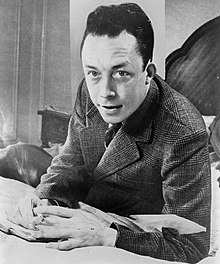
On this day, 1913, Albert Camus was born in French Algeria

Albert Camus, gagnant de prix Nobel, portrait en buste, posé au bureau, faisant face à gauche, cigarette de tabagisme.jpg
"
"Every time somebody speaks of my honesty, there is someone who quivers inside me."

Search This Blog

My Blog List