I think the bond between the writer and the reader is very important. One writes the story; that is the writer’s part done. Then the reader gets to work; reading is his job. I have always enjoyed that connection with the reader I haven’t met but feel I know because of having shared an experience: the story.
William Trevor, one of world's finest writers, is interviewed at Irishtimes.com
Saturday, April 16, 2011
Sunday, April 10, 2011
Reading: Norwegian Wood/ Haruki Murakami
Who is the best and most interesting character in Haruki Murakami's Norwegian Wood? Naoko, Midori, Reiko? Nagasawa,Kizuki, Hatsumi? Watanabe himself?
In my recent read, I find the novel a bit mushy, and not as good as Haruki's other works. May be this was his debut novel - which made him famous, though - and he was still trying to find his own voice and style.
NW has plenty of sex scenes which seem like the printed version of yesterday's blue films, but the thing that astounds me is that they look like natural in the setting of the narrative involving an adolescent and his friends. There is not much you can complain against the writer because he writes it as convincingly as it happens in real life. Kind of new reading experience for me.
The narrative is not that strong: Nagasawa is womaniser and careerist without any sense of morality, Hatsumi and Midori are regular girls aspiring for happy conjugal life. Naoko is a bit incredible as a character who,like her former boy-friend Kizuki, commits suicide in the end. Her long relaionship with Watanabe has not exactly got to a logical end and the readers are not given any clue about her exact illness.
The best portrayed character is Reiko. And she actually saves the novel.
In my recent read, I find the novel a bit mushy, and not as good as Haruki's other works. May be this was his debut novel - which made him famous, though - and he was still trying to find his own voice and style.
NW has plenty of sex scenes which seem like the printed version of yesterday's blue films, but the thing that astounds me is that they look like natural in the setting of the narrative involving an adolescent and his friends. There is not much you can complain against the writer because he writes it as convincingly as it happens in real life. Kind of new reading experience for me.
The narrative is not that strong: Nagasawa is womaniser and careerist without any sense of morality, Hatsumi and Midori are regular girls aspiring for happy conjugal life. Naoko is a bit incredible as a character who,like her former boy-friend Kizuki, commits suicide in the end. Her long relaionship with Watanabe has not exactly got to a logical end and the readers are not given any clue about her exact illness.
The best portrayed character is Reiko. And she actually saves the novel.


Friday, April 8, 2011
V.S Naipaul interview
The certainty that all is going to be all right since one was serving this noble cause.the thought of being a writer - there's a kind of purity, a blessing, and I'm trying to define this thing about being a writer. This sums it up quite well. It gets the solitude, the touch of aggression and it also makes clear why people don't always like young men who are writers - not always attractive, because unhappy a lot of them, unfulfilled. I used to suffer from rages during this period. In public. But that was a passing phase.
Sunday, April 3, 2011
Jennifer Egan interview
Q:There’s been a lot said about your writing process — writing on yellow legal pads without re-reading a word until you start feeding the words into the computer. How did that method evolve for you?
A:Well, when I started writing, in high school, I had a manual typewriter. And then I had an electric typewriter. So in those years, writing by hand was the most flexible way to go. By the time I started using a computer, halfway through college, I was used to handwriting my fiction. I did write stories on a computer for a year or two, but then I drifted back to my old ways. The bottom line is that I like my first drafts to be blind, unconscious, messy efforts; that’s what gets me the best material.And there’s no way for me to achieve that effect while staring at every word I write in typeface. So I’m led, inevitably, back to the legal pads, and ord I write in typeface. So I’m led, inevitably, back to the legal pads, and my illegible scrawl. It isn’t so much that I don’t reread as that I can’t, without serious effort.
A:Well, when I started writing, in high school, I had a manual typewriter. And then I had an electric typewriter. So in those years, writing by hand was the most flexible way to go. By the time I started using a computer, halfway through college, I was used to handwriting my fiction. I did write stories on a computer for a year or two, but then I drifted back to my old ways. The bottom line is that I like my first drafts to be blind, unconscious, messy efforts; that’s what gets me the best material.And there’s no way for me to achieve that effect while staring at every word I write in typeface. So I’m led, inevitably, back to the legal pads, and ord I write in typeface. So I’m led, inevitably, back to the legal pads, and my illegible scrawl. It isn’t so much that I don’t reread as that I can’t, without serious effort.
Sunday, March 27, 2011
Ruskin Bond interview
Q:Did you ever feel demoralised as a writer?
A:Yes, about 20-30 years ago, when I felt that my writing wasn’t being appreciated. But in the last few years, my readership has grown.
more
A:Yes, about 20-30 years ago, when I felt that my writing wasn’t being appreciated. But in the last few years, my readership has grown.
more
Saturday, March 26, 2011
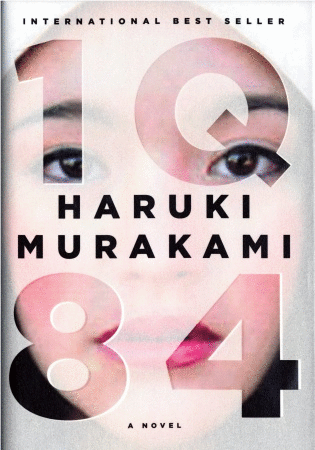
1Q84 Cover unveiled
The English translation of Haruki Murakami's 1Q84 is yet to hit the market - oh, how long I've been waiting for the book - but the cover of the US edition of the translation is just out.(Via Literary Saloon). And I like it.

Saturday, March 19, 2011
IMHO U R GR8: Texting in literature
It is the relentless onward march of the texters, the SMS (Short Message Service) vandals who are doing to our language what Genghis Khan did to his neighbours eight hundred years ago.
They are destroying it: pillaging our punctuation; savaging our sentences; raping our vocabulary. And they must be stopped.
Thursday, March 17, 2011
Sunday, March 13, 2011
Thirtieth anniversary of Alasdair Gray's Lanark
When Alasdair Gray published his novel Lanark thirty years ago, Anthony Burgess had these words: It was about time Scotland produced a shattering work of fiction in the modern idiom. This is it. The first major Scottish novelist since Sir Walter Scott.
The thirtieth anniversary of the novel is being celebrated now.
The thirtieth anniversary of the novel is being celebrated now.
Tuesday, March 8, 2011
Friday, March 4, 2011
Hanif Kureishi on the art of writing
The piece of writing I usually most enjoy doing is inevitably the thing I'm not supposed to be doing, so it can seem illicit. I like to work on something over a long period, returning to it repeatedly, adding, subtracting and altering, and taking advice from editors and friends, until I can't bear to look at it, which is when I guess it's done. Writing is highly labour intensive. It takes a lot of time – and much patient toleration of boredom, frustration and self-loathing – to achieve anything. Then you try to sell something to the world it doesn't know it needs.
Tuesday, March 1, 2011
Friday, February 25, 2011
Another Arundhati Roy interview
I don’t really do research in order to write. Finding out about things, figuring out the real story—what you call research—is part of life now for some of us. Mostly just to get over the indignity of living in a pool of propaganda, of being lied to all the time, if nothing else.
In Guernica,Amitav Kumar interviews Arundhati Roy.
In Guernica,Amitav Kumar interviews Arundhati Roy.
Wednesday, February 23, 2011
Why China has no great writers now
"Why is contemporary China short of works that speak directly? Because we writers cannot speak directly, or rather we can only speak in an indirect way Why does contemporary China lack good works that critique our current situation? Because our current situation may not be critiqued. We have not only lost the right to criticise, but the courage to do so; Why is modern China lacking in great writers? Because great writers are castrated while still in the nursery.
"
"
Monday, February 21, 2011
H.M. Naqvi interview
Q:Of late, one is noticing a reverse brain drain to Pakistan with well established writers coming back home, and making Pakistan their place of residence: Daniyal Mueenuddin, Mohsin Hamid and Hanif besides you. Is it something about the home country that is attracting the writers back, a kind of nostalgia or the feeling of being an outsider in the West?
A:I don't have empirical data on the matter. I can, however, speak for myself. I returned because I had no money. In any event, there's no place like home. I love Karachi. It's a wonderfully animate city. There are people on the beach at two in morning, traffic at three. You can have breakfast at four – halva, puri – and nihari at five. Moreover, as a writer I wouldn't want to be elsewhere for long. There's a story under every stone.
A:I don't have empirical data on the matter. I can, however, speak for myself. I returned because I had no money. In any event, there's no place like home. I love Karachi. It's a wonderfully animate city. There are people on the beach at two in morning, traffic at three. You can have breakfast at four – halva, puri – and nihari at five. Moreover, as a writer I wouldn't want to be elsewhere for long. There's a story under every stone.
Saturday, February 19, 2011
How and where do you find material for your books?
Answers from three writers
I find it among people. I find it in tiny rooms and in passenger terminals, in dreams, in books, and in experiences from the past that are the poetry of memories. I find it among the streets in which I grew up. I find it in my senses. Imagination is the extension of experience.
-Lars Saabye Christensen,Norwegian novelist
I don't know. What I know is that there is a certain way of life I have to live in order to be able to write the best I can. It doesn't mean only having enough free time and space, but also trying to avoid everyday stereotypes, traveling, doing adventurous things, experiencing uncertainty. That is what I need. My mind is what matters. Topics and material then come by themselves.
-Petra Hulova,Czech writer
In life, in my memories, in family history, friends' stories, textbooks, newspapers, television, documents, archives. I think it depends more on how you look at things than on the things themselves.
-Jenny Erpenbeck, German writer
I find it among people. I find it in tiny rooms and in passenger terminals, in dreams, in books, and in experiences from the past that are the poetry of memories. I find it among the streets in which I grew up. I find it in my senses. Imagination is the extension of experience.
-Lars Saabye Christensen,Norwegian novelist
I don't know. What I know is that there is a certain way of life I have to live in order to be able to write the best I can. It doesn't mean only having enough free time and space, but also trying to avoid everyday stereotypes, traveling, doing adventurous things, experiencing uncertainty. That is what I need. My mind is what matters. Topics and material then come by themselves.
-Petra Hulova,Czech writer
In life, in my memories, in family history, friends' stories, textbooks, newspapers, television, documents, archives. I think it depends more on how you look at things than on the things themselves.
-Jenny Erpenbeck, German writer
Monday, February 14, 2011
Leila Aboulela interview
"And those early years of my life in Sudan are still my bearing and measure. But I went in a different direction. That was my fate."
Leila Aboulela, Sudanese writer, is interviewed at Times Live.
Leila Aboulela, Sudanese writer, is interviewed at Times Live.
Sunday, February 13, 2011
Edna O'Brien interview
"When I read something thrilling or I write a good line. When I have a lovely drink - I drink white wine or champagne. When I'm with someone, usually it's one other person, rather than a crowd, whose intelligence and stimulatingness is great. Because one wants to be both inside one's self and removed from one's self. Those things make me happy.
"Nature makes me happy, even though I live in the city, deliberately; I don't think I have the inner resources to live alone in the country. I wish I knew more about music. I listen to classical music, and sometimes I am bestirred, but language is my first love in the arts, and then painting. I love paintings."
"Nature makes me happy, even though I live in the city, deliberately; I don't think I have the inner resources to live alone in the country. I wish I knew more about music. I listen to classical music, and sometimes I am bestirred, but language is my first love in the arts, and then painting. I love paintings."
Tuesday, February 8, 2011
Saturday, February 5, 2011
Subscribe to:
Posts (Atom)
Subscribe To


 Posts
Posts
My Blog List
-
-
-
Uketsu profile6 days ago
-
-
-
-
Briefly Noted Book Reviews2 years ago
-
-
-
-
Literary family feuds6 years ago
-
In Her Own Time: Mari Coates6 years ago
-
-
-
Moving Announcement!8 years ago
-
The Real World is emerging now9 years ago
-
-
Donald Trump’s New Deal10 years ago
-
-
-
-


